How I celebrate the New Year

January 2nd, 2009

adams_denos

Deno’s 6&85  ©2009 Deidre Adams.

It seems that the beginning of a new year is a time for most people to want to take stock of their lives and to resolve to change themselves in some way. I decided a long time ago that making resolutions was a sure setup for failure. So, although there is a tiny nagging sense of guilt that I should be working to improve myself in some way, I pass on the whole resolution thing and just allow myself to enjoy the day. Is that because I’m weakwilled? Perhaps, but I much prefer to live in the moment than to spend the day in deep introspection, self-absorption and recriminations, thinking about how I should change myself.

So, yesterday when I saw that it was a beautiful warm day with striking clouds — my optimal picture-taking scenario — I decided it was time to take advantage of a quiet traffic day and go up north to Commerce City to get some shots of Deno’s 6&85 restaurant, with this fabulous old sign. I’m not sure why, but it evidently has some claim to fame, as it’s the poster child for the “truck stop” entry on Wikipedia. I’d heard that they had closed, so I thought I’d better get up there before it got torn down. I was quite surprised to find that it’s now plastered with ugly banners announcing that they’re now open under new management. Kind of ruined the atmosphere I was hoping for, but whaddaya gonna do!

adams-denos-closeup1

Here’s a closeup of the sign in which you can see a couple of the current residents. These birds were quite happy and noisy yesterday, giving the whole scene an oddly surreal spring-like feeling, there on the first day of January, 2009.

We spent some time driving around Commerce City, a great urban exploration area, for other photo opportunities. Late in the afternoon, the sun came poking through a cloudbank and produced this great scene in the concrete labyrinth that lives underneath I-70:

adams_underpass

Underpass. ©2009 Deidre Adams.

Disclaimer: All of these images are tweaked in Adobe Lightroom, to which I am now heavily addicted.

But to get back to the New Year’s theme, I got a bonus in my e-mail today in the form of permission for my lazy behavior. This comes from Robert Genn’s Twice Weekly Newsletter, which I subscribed to a while ago. Although most of what he offers is a rehash of the same-old stuff that you’ve heard a gazillion times if you’ve been around awhile, every now and then there is a gem worth contemplating. Today’s offering is called How to Find Passion. I read through the typical life turnaround story barely paying attention, but there were a couple of steps in his how-to list that made me stop in my tracks:

Consider your dreams to be private, unique and sacred….
Don’t talk about it, do it.

OK, great. Gotta stop talking about it, and go do it. Until next time, then!

Concrete Cathedrals — Robert L. Jones

December 23rd, 2008

I haven’t posted for awhile because I’m deep in the throes of updating my web site — I thought the break between semesters would be a good time for that. But for some reason, I always underestimate the scope of this project and it always takes so much longer than it ought to. I needed to take a breather from that and think about something else for a bit, and looking at work by other photographers is always a worthwhile endeavor.

jones-cc_5cSan Antonio, Texas, January, 2001    ©Robert L. Jones

Robert L. Jones is a photographer and writer with whom I’ve corresponded off and on for a couple of years after he contacted me through my web site. I’ve not met him personally, but his work really appeals to me because a lot of it has a reverence for the same things that I am drawn to: the anachronistic image of a place that time seems to have forgotten, a chance composition discovered by looking down at the ground, and the majestic grain elevator.

This latter subject is a particular specialty of Jones’, and it’s obvious from the title he gives them that he holds them in high esteem. I’ve learned from looking at these photos that the oddly tilted perspective appearing unbidden in some of my own work is not a thing to be repudiated, but is rather something to be embraced for the dynamic presence it imparts to an image of a static subject. I’m especially intrigued by the above image because of the abrupt shift in the tonal value of the building on the right. It draws me in to thinking about what might have happened here: were they still in the process of painting this building when the photo was taken, or had they long since given up, interrupted by perhaps a financial disaster and never to return to the project? (I suppose I could research the matter and find out, but I prefer to wonder.) This demarcation line also forms a continuation of the strong diagonal started by the building on the left, creating a compelling composition.

Jones is something of a purist in his methods, preferring to work with film and doing his own developing and printing on coveted favorite papers, painstakingly working to perfect his technique, and refraining from fully accepting the label of “artist” until he feels he has done so. I find this admirable in our age of instant gratification. However, I must take just a tiny bit of exception to one thing he says in a discussion of his philosophy: “More so than any other artistic medium, photographers pride themselves in mastering technique, i.e., craft, and in perfecting each stage of the … process.” It isn’t that I don’t believe photographers do this, it’s just that I know artists in other media do so also, as I am personally aware of many textile artists who are completely obsessesed with perfecting their process. It seems that photography suffers some of the same crisis of identity that textile art suffers: is it art, or is it a craft?

I guess I’ll go out on a limb here — how could such a framing of the Phillips 66 station in its Technicolor brilliance be anything other than art?

jones-rte87abernathy
U.S. Route 87, Abernathy, Texas, February, 2002       ©Robert L. Jones

Speaking in Cloth: 6 Quilters, 6 Voices at RMQM, Golden, Colorado

December 8th, 2008

Adds Up, 77 x 54 inches, ©2005 Cynthia Corbin

The Rocky Mountain Quilt Museum in Golden, Colorado is dedicated to the preservation of the art and history or American quilt making. They maintain a permanent collection of quilts with historical significance and offer exhibitions and educational events in the support of their mission. The exhibitions include both historical as well as contemporary offerings. This past weekend, I had the pleasure of seeing the Speaking in Cloth: 6 Quilters, 6 Voices exhibition in person. I’ve had the book for awhile now, and I wrote about Jeannette DeNicolis Meyer’s work in a previous post. But it was a treat to see all the work in person, as photos usually don’t do justice to textile work, missing the nuances of texture and depth that are visible in the piece when you see it face-to-face.

Jeannette DeNicolis Meyer’s rich color and beautiful hand stitching create a lush environment of subtle light and shadow play on each rich surface. Ann Johnston uses her signature dye-painting techniques along with a diverse vocabulary of stitch patterns for her complex and dynamic compositions. Quinn Zander Corum includes beading and hand-stitching to invite the viewer to come in close for a better look. Her piece “The Back Forty,” consisting of 40 fully-developed small compositions, is a library of colors and techniques reminiscent of the traditional sampler quilt. Nancy Erickson invokes an ancient world where animals rule, realized with her personal iconography of cave paintings and her exhuberant brushwork. Trisha Hassler puts a unique spin on her mixed media work: she combines jagged, rusted steel with counterpoints of hand-dyed, quilted fabric pieces in a harmonious blending of hard and soft. Cynthia Corbin’s work is fascinating for its use of texture, both in the patterning of the fabrics as well as in the amazingly dense machine quilting which covers each piece. Her piece “Adds Up” is shown above, and here is a detail:

My only complaint about the show is that the exhibition space is unfortunately rather small, resulting in a very crowded show with pieces stacked one on top of the other. Some of the smaller works, which would have benefited from an eye-level viewing, were placed too high to see properly. But in any case, I highly recommend going to see this show. It’s up until January 31, 2009.

Also currently on view at the Museum is California Gold, an exhibit of quilts made in the 1870s and 1880s which include a warm yellow fabric of a color nicknamed “California Gold.” The exhibit honors the 150th anniversary of the Forty-Niners, pioneers who risked everything to travel west for the gold rush.

Turkey Tracks, 74 x 85 inches, c. 1885, collection of the Rocky Mountain Quilt Museum

The signage for this piece reads “Woe betide the quiltmaker who decided to stitch this pattern for her son! Turkey Tracks, also known as ‘Wandering Foot,’ was thought to encourage people who slept under it to become endless wanderers … especially boys.”

First Friday Art Walk in Denver

December 5th, 2008

Reflections, 38 x 92, ©2008 Deidre Adams

UPDATE - 2:15 pm
Just found out from gallery manager they are NOT planning to be open tonight. I apologize if anyone is inconvenienced by this!

———————————————————————

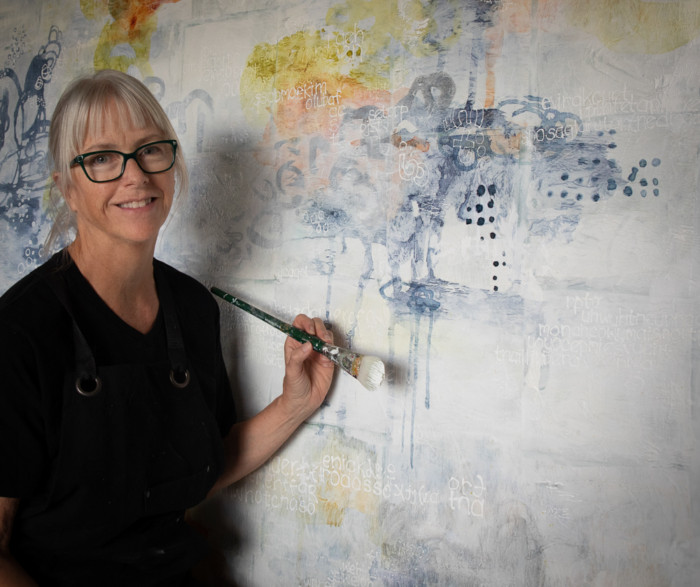
As today is the first Friday in December, this means tonight there will be another opportunity to peruse the galleries in Denver’s ArtDistrict on Santa Fe, including Translations Gallery, where my solo show continues through January 2. Above is one of my latest works which is on exhibit at the gallery. This is the end result of the piece that you can see me working on in the video on the gallery’s home page.

Also, a reminder to anyone in the Denver metro area that the Speaking in Cloth: 6 Quilters, 6 Voices exhibition, featuring the work of Ann Johnston, Jeannette DeNicolis Meyer, Cynthia Corbin, Nancy Erickson, Quinn Zander Corum, and Trisha Hassler, is currently showing at the Rocky Mountain Quilt Museum in Golden, through Jan. 31, 2009.

Small Art Showcase

December 3rd, 2008

Metamorphosis 1, ©2006 Deidre Adams

SmallArtShowcase.com, organized by artist Jeanne Williamson, features the work of several artists who are making their work accessible and affordable to art lovers and collectors through a special collection each has created for the showcase. All works featured in the showcase are priced between $25 and $500. Sales are made through the individual artists, and the artists keep 100% of the proceeds. Please consider supporting these artists either by making a purchase or by spreading the word about this site.

I’ve been wanting to move toward getting visibility for my photography in addition to my mixed media work, so this seemed like the perfect opportunity. My Small Works Showcase pages feature several of my “found art” abstract compositions and some urban landscape images, as well as more abstracts from a series I took of rocks at a beach in the Palos Verdes Peninsula in California in 2006. The image above also came from the Palos Verdes trip. It’s a closeup of a rusty metal pipe that marked the beginning of the hiking trail we were on.

Translations Gallery show

November 7th, 2008

Façade V, 38 x 63 inches. ©2008 Deidre Adams.

Translations Gallery show opens tonight. After many weeks of preparing, getting new work finished, trying to come up with solid words to articulate my vision, and editing and preparing photos to go with the exhibition, it seems the big day of the opening has finally arrived. In the meantime, I’ve also been working on school assignments and then there was that little thing about an election. (Don’t you just hate people who go on and on about how busy they are? OK, I’ll shut up about that now.)

I went by the gallery yesterday where they were almost done hanging the show. It was a very cool thing seeing so much of my own work displayed in one place. The gallery owner and manager are simply amazing, and I cannot thank them enough for everything they’ve done, including mounting a lot of the work, sending out announcements and press releases, putting together an iPhoto book of my work, and commissioning a video of me talking about my work (currently visible on the home page of the gallery site but will probably move, so I’m not linking to it directly).

There is also another person who makes it possible for me to do what I do, and I am often remiss in expressing my gratitude to him. I’m talking about my husband, Joe, who works tirelessly cooking meals, making canvas frames and boards for me, fixing computer problems, being the parent contact with and volunteering at our son’s school, getting cars fixed, and doing a gazillion other things that free up my time to make art, not to mention being amazingly supportive even when he probably wants to thrash me.

OK, enough mushiness. Back to getting ready!

You’re not helping!

October 17th, 2008

Potential.  ©2003 Deidre Adams.

I’m sure many of you have noticed how language in the art world can be extraordinarily abstruse at times. (I’m using this word intentionally so I can show off how erudite I am; to impress you lowly commoners with my recondite credentials.)

I’m taking a class right now called Art of the 20th & 21st Centuries. The topic is really interesting, and the instructor is great. Her lectures are clear and informative, and we have some great discussions in the class. I love learning about the progression of the different movements throughout this time.

BUT … the textbook, “art since 1900: modernism, antimodernism, postmodernism,” is an enormous stinking pile of self-serving gobbledygook. The authors have no intention of being informative, so that the reader might actually learn something valuable. Rather, it reads as though they are just sitting around in some kind of academic salon pontificating and showing off to one another.

An example of a typical writing exercise question:

What is aesthetic autonomy? What do you think the authors mean, then, when they talk about “artistic acts” negating or refusing “instrumentalized experience”?

Well, okay, you might think to yourself. This probably has something to do with Dada, an “anti-art” movement that formed as a protest against the “bourgeois capitalist society that had led people into war,” expressing their ideas in ways that “appeared to reject logic and embrace chaos and irrationality.”

But in the textbook, the avoidance of actually defining “aesthetic autonomy” reads like this:

German philosopher Jürgen Habermas (born 1929) has defined the formation of the bourgeois public sphere in general and the development of cultural practices within that sphere as social practices of subjective construction of bourgeois individuality. These processes guarantee the individual’s identity and historical status as a self-determining and self-governing subject. One of the necessary conditions of bourgeois identity was the subject’s capacity to experience the autonomy of the aesthetic, to experience pleasure without interest.

Self-determining and self-governing, well that makes sense more or less, but how, exactly, does one go about experiencing pleasure without interest?

As far as “instrumentalized experience,” we have this gem:

The modernist aesthetic of autonomy thus constituted the social and subjective sphere from within which an opposition against the totality of interested activities and instrumentalized forms of experience could be articulated in artistic acts of open negation and and refusal. Paradoxically, however, these acts served as opposition and — in their ineluctable condition as extreme exceptions from the universal rule — they confirmed the regime of total instrumentalization. One might have to formulate the paradox that an aesthetics of autonomy is thus the highly instrumentalized form of noninstrumentalized experience under liberal bourgeois capitalism.

Huh? My brain hurts. Here’s a good, funny post on “artspeak” by Jason Brockert that we all ought to take heed of. Take a look at his web site, too — some wonderful, thought-provoking work.

The unbearable lightness of show rejections

October 10th, 2008

Composition VIII, 39 x 39, ©2008 Deidre Adams

Ahh, Quilt National. The Holy Grail of art quilting excellence. The Nirvana to which all we faithful makers of quilted textile art aspire! Its fickle clarion call, beckoning faithfully once every two years, cannot be ignored nor disdained. Each time it comes around, I faithfully put together my entry, being careful to follow all of the rules lest I end up that most pitiable of creatures, the person who gets summarily kicked out in disgrace — what fate could be worse than that? Each time then, I hold my breath, hoping, waiting…

And all but one of those times for the past 5 shows, has come the rejection. No, they say, you are not worthy. Go back and do not darken our door again until you have sweated and slaved and produced a masterpiece from which we do not recoil in horror.

All kidding aside, though, I did receive my rejection notice from QN a couple of weeks ago. And it’s true what they say: the more rejections you get, the easier it becomes to shake it off and move on. Plus, since the initial notice came by e-mail, it really did seem inconsequential to me this time. None of that anticipation as when you pull the envelope out of the mailbox, fingering it carefully, trying to figure out if all the slides you sent them have come back to you.

The piece above, Composition VIII, is one of the works I had entered this year. I feel in my heart that it is without doubt the finest work I have ever made. It expresses precisely and without fuss exactly what it is I am trying to say with my work. (Does that sound amazingly conceited? I was told by someone yesterday that I self-censor way too much, so perhaps that statement is a bit of a passive-aggressive reaction to that idea.) So I say to you, Quilt National, your loss!

Other people that I’ve shown this piece to have had lukewarm reactions to it also, so it’s yet another example of a paradox that I often find in making art. The work that I think is positively my best doesn’t seem so to others, and the things I get the best reactions to are often those that I feel weren’t particularly strong. Does this mean I’m not a good judge of my own work? Perhaps yes, perhaps no. In either case, it’s proof once again that you really need to make work for yourself and not be trying to guess what others might like or what might be sellable.

Possibly another reason why the QN rejection didn’t bother me too much is that during the months of October and November this year, I will be having a solo show at Translations Gallery. This is very exciting news for me, and I’m certainly honored to have this opportunity. The gallery owner and manager have a lot of great ideas for promoting the show, including hiring a professional production company to make a video about my art. There have been two sessions of taping so far, a nerve-wracking experience for me, but they were great at working with me to get through my fears. I can’t wait to see the final result.

I’m busily making some new pieces to go in this show, and I am also getting some of my photography together to include with the exhibit. It’s a lot to pull together in the couple of weeks I have left, but I have some good ideas and lots of energy right now. Fall is always a good time for me.

Christo & Jeanne-Claude, 12 Voices opening

September 24th, 2008

Last Thursday, I had the pleasure of attending a lecture by Christo and Jeanne-Claude, who were here in conjunction with their Prints and Objects exhibition currently on view at the Center for the Visual Arts in Denver. Christo and Jeanne-Claude are legendary for their environmental works done on a massive scale, the most recent of which was the Gates project in New York’s Central Park. I had also gone to the exhibition the day before as part of a class field trip, wondering beforehand what kind of things they did that could possibly be small enough to fit in this venue. It turns out that the items on exhibit are not standalone works of art, but they are preparatory sketches, limited-edition prints, and photographs all relating to their large-scale works.

The lecture consisted of a short screen presentation followed by a question-and-answer session. They showed images of several projects from the research stage, through drawings and sketches of the proposed project, and photos of meetings with local residents and officials in the vicinity of the proposed project. The scope of planning and logistics of these projects is simply mind-boggling. The time frame for a single project can span many years from initial concept to finished work. For example, the web page for The Gates lists the years as 1979-2005, a span of 26 years!

By far the most interesting part of the event was at the end when they took questions from the audience. Jeanne-Claude did most of the talking, and she stressed that everything they do is done from the heart, for the sheer joy and beauty that it gives them personally. The work is not done for others, but if others enjoy it, that’s a bonus. (Something many of us know intuitively that we should also strive for, but it’s often a struggle.)

12 Voices opening

12 Voices exhibition at the Dennos Museum Center

On Sept. 13, I attended the opening reception for 12 Voices, at the Dennos Museum Center in Traverse City, Michigan. The Museum Center is a beautiful venue, and the show was hung with good attention to flow and with plenty of room for each piece to be appreciated on its own as well as in context with its neighbors. Seven of the twelves artists were able to attend: Judith Content (the current SAQA president), Joan Schulze, Ginny Smith, Merle Axelrad Serlin, Kathy Weaver, and Teresa Barkley, and me. (I got to be roommates with Joan and Teresa, and getting to know them was a definite highlight of the trip. More on that later.)

Penny McMorris, the 12 Voices curator, gave a marvelous lecture on the artists and the work in the show. It was wonderful to hear the inside story on these artists (even though I knew a lot of it from working on the catalog) as well as Penny’s own interpretation on the work. I was fascinated to hear what she had to say about my own work, as it provided some insights that I hadn’t thought about but realized were absolutely true.

Nelson Armour, Kathy Weaver’s husband, took some great photos at the opening (thanks, Nelson!). Above is a photo he took of me next to my piece, Composition IV. To the left is Linda Colsh’s Cold Shoulder.

This is Teresa Barkley with me at the reception (photo also by Nelson Armour). The Dennos put on a great spread, with wonderful food and wine, before the lecture. All in all, it was a great trip. I spent a couple extra days there exploring the area; more on that later.

Where does the time go?

September 4th, 2008

Good intentions out the window. Distractions abound. So many things needing to get done, paralysis sets in. My goal of doing at least one post per week is woefully unfulfilled, but does anyone besides me care? I promised myself I would not use the blog to whine or to navel-gaze, though, so no excuses.

One of the things we try to do every summer is go on a photographic scouting road trip. Due to me taking a summer class, though, and fall semester starting way early this year, a road trip just didn’t happen. But the good news is, I have lots of photos from past trips that I need to do something with. So I’ll start posting some of these on a regular basis.

The above was taken on last year’s trip. The location is in eastern Wyoming, on a 2-lane highway, slightly north of a town called Douglas. The clouds were looking quite photogenic that day. The above image is enhanced in my very favorite toy, Photoshop Lightroom. I recently upgraded to version 2.0; still need to figure out all the great new stuff it does. But in the meantime, you can do some very amazing things to your images, all non-destructively and completely reversible.

Below is the original image:

It’s not horrible, but the clouds look rather flat and the whole thing needs some punch. A few quick tweaks in Lightroom, and the added contrast results in the top image — much more interesting. I love Photoshop, but it does have a steep learning curve and simple editing tasks take a lot longer. For quick editing and amazing organizational capabilities, Lightroom is the way to go.

And you can push it a lot further to get some very creative effects. Here’s an experiment with the parameters taken well beyond “normal” limits:

Other fun activities this week included getting my Quilt National entry in just under the wire (due date Sept. 5), and shipping my work for the 12 Voices show, which opens next week at the Dennos Museum Center in Traverse City. Also, tomorrow is the opening for Threadlines 2008, an exhibit sponsored by Uncommon Threads at the Missouri State University Art & Design Gallery, September 5-29, 2008, co-organized by Pam RuBert and Emmie Seaman. My piece, Chroma Study #2: Blue and Red, will be a part of the exhibition.

Chroma Study #2: Blue & Red, ©2008 Deidre Adams

Next »